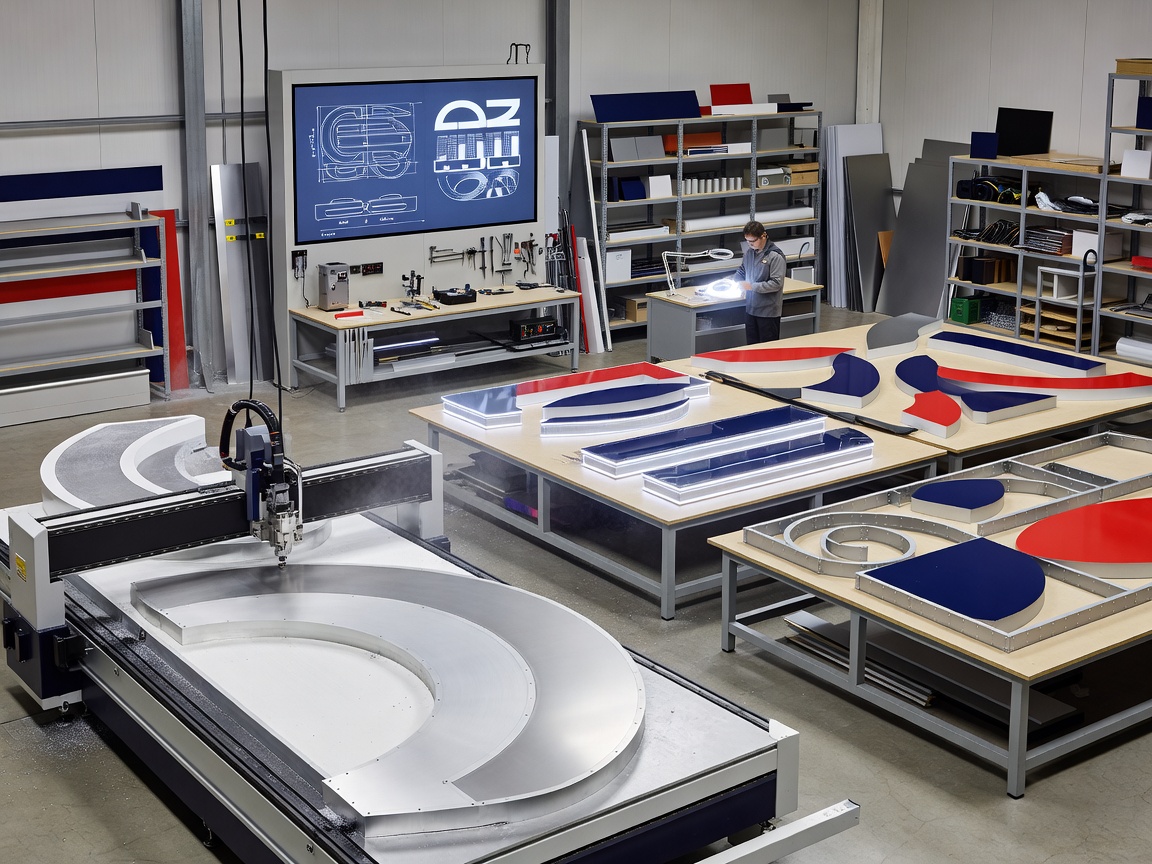
Start with the sign family
Stadium signage rarely consists of one format. A venue may need external identification, entrance signs, gate numbers, directional panels, sector markers, information boards and zone labels. Each has a different information load and viewing condition.
Manufacturing planning begins by grouping signs into families. The family defines dimensions, typography, colour application, fixing logic and finishing. It also reduces avoidable variation between locations.
Close viewing and long viewing
Signs designed for close viewing can carry more detail. They may include instructions, maps or several lines of supporting text. Signs intended to be read from a greater distance need fewer words, stronger hierarchy and clearer contrast. Their location matters as much as their artwork.
Arrival signs, gate identifiers and high-level markers usually need quick recognition. A panel beside a ticket checkpoint can support slower reading. Treating both as the same object creates either visual noise or insufficient information.
Materials, exposure and compatibility
Material selection should reflect exposure, cleaning routines, impact risk, mounting surface and the visual character of the venue. Indoor concourses, open approaches and service areas may require different choices. Material decisions should be checked against the intended finish and maintenance method.
Production must also consider installation compatibility. A finished sign needs the right fixing points, edges, weight assumptions and access arrangement. These details should be resolved before manufacture rather than discovered on site.
Typography and colour control
Typography must remain legible at the expected distance and under the available lighting. Hierarchy should distinguish the main destination from supporting detail. Colour contrast should support recognition, not simply decorate the panel.
Use a controlled palette. Assign colours to useful functions such as zones, routes or warnings. Record the chosen values and reproduce them consistently across sign families. A colour that changes between production batches can weaken the wider information system.
Quality checks and maintenance
Review artwork, spelling, numbering, dimensions, fixing details and finish before release. Keep a schedule that links each sign to its location and family. This supports replacements and future changes.
Maintenance planning includes cleaning access, visibility checks, damaged faces, loose fittings and information updates. A sign that cannot be reached or identified in the schedule becomes an operational burden.
Checklist
- Classify every sign by function and viewing distance.
- Confirm dimensions, contrast, materials and mounting assumptions.
- Coordinate artwork with the installation schedule.
- Record locations, revisions and maintenance notes.
What to know
Manufacturing quality is not only a finish decision. It is the result of information hierarchy, repeatable production and installation compatibility.