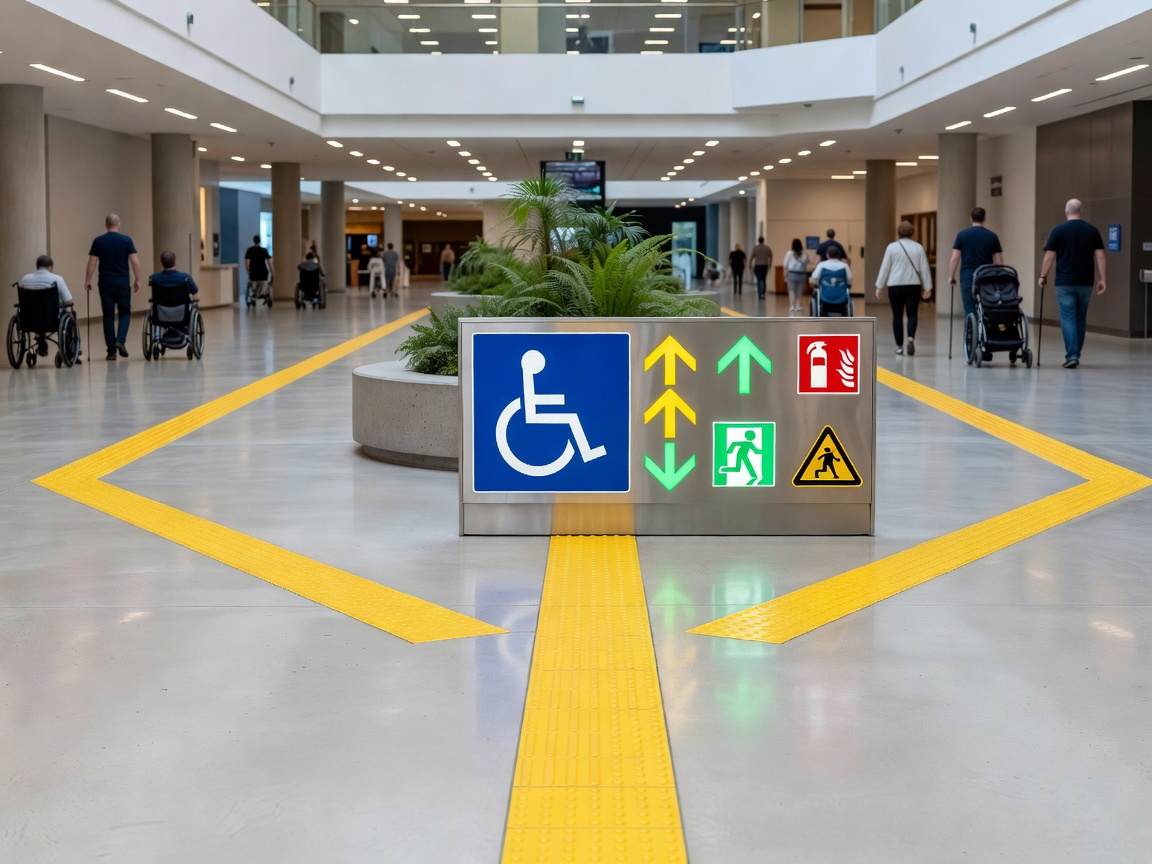
Separate information by purpose
Accessibility information helps people identify routes, entrances, facilities and seating options. Safety signage communicates hazards, restrictions, emergency information or evacuation-related directions. These purposes may share a visual language, but they should not compete on one panel.
Define the message before selecting a sign. A short directional instruction may need an arrow and symbol. A facility identifier may need a universally recognisable icon and supporting text. Emergency information may require a controlled format approved for the venue.
Readable typography and contrast
Readable typography depends on type size, letter spacing, contrast, viewing distance, lighting and background. Avoid decorative treatments that weaken recognition. Keep line lengths controlled and use hierarchy to distinguish the destination from supporting detail.
High contrast supports scanning, but colour alone should not carry meaning. Pair colour with words, symbols, shape or position. The final design should be reviewed in its actual environment rather than only on a screen.
Accessible route information
Accessible routes should be represented consistently wherever a visitor makes a route decision. Identify changes in direction, entrances, lifts, accessible facilities and alternative routes where relevant to the venue plan.
Do not assume that a symbol makes the route self-explanatory. The surrounding sign system should provide enough context for a visitor to understand where the route leads.
Safety and emergency communication
Evacuation-related signage is a general category requiring venue-specific planning. Content, placement and symbols must be checked against applicable fire-safety, building, accessibility and venue requirements. Qualified professionals and the relevant jurisdiction should confirm compliance.
This page does not provide emergency procedures or legal advice. A signage schedule should identify ownership, review status and inspection responsibility for safety information.
Language and maintenance
Multilingual information may be appropriate where visitor groups require it. Translation should preserve the hierarchy and meaning of the original message. Avoid crowding a panel with unplanned language additions.
Visibility checks should cover dirt, damage, obstructions, lighting changes and construction work. Requirements can differ by jurisdiction and venue type. Review them before design approval and again when conditions change.
Checklist
- Separate accessibility, directional and safety messages.
- Review typography, contrast, symbols and viewing distance.
- Map accessible routes and repeat information at decisions.
- Obtain qualified jurisdictional review for applicable requirements.
What to know
Clear safety and accessibility signage supports navigation, but it does not replace professional compliance review, operational planning or emergency management.